The Philippines is bracing for yet another powerful storm as Typhoon Fung Wong, known locally as Uwan, has been officially upgraded to super typhoon status. The massive storm system made landfall early Sunday, bringing violent winds, torrential rain, and what authorities described as “life-threatening conditions” to several eastern regions of the country.
According to the Philippine Atmospheric, Geophysical and Astronomical Services Administration (PAGASA), Fung Wong is packing sustained winds of up to 185 km/h (155 mph), with gusts that could exceed 230 km/h (143 mph). The storm’s enormous diameter and slow forward movement mean that multiple regions are likely to experience prolonged rainfall and destructive winds well into Monday.
The eastern Bicol region was the first to feel the storm’s full force on Sunday morning, with waves crashing into coastal villages and power outages reported in several provinces. PAGASA has warned that the northern island of Luzon, home to nearly half of the country’s population, will experience the worst impacts later on Sunday night and into the early hours of Monday.
A Nation Still Reeling from Kalmaegi
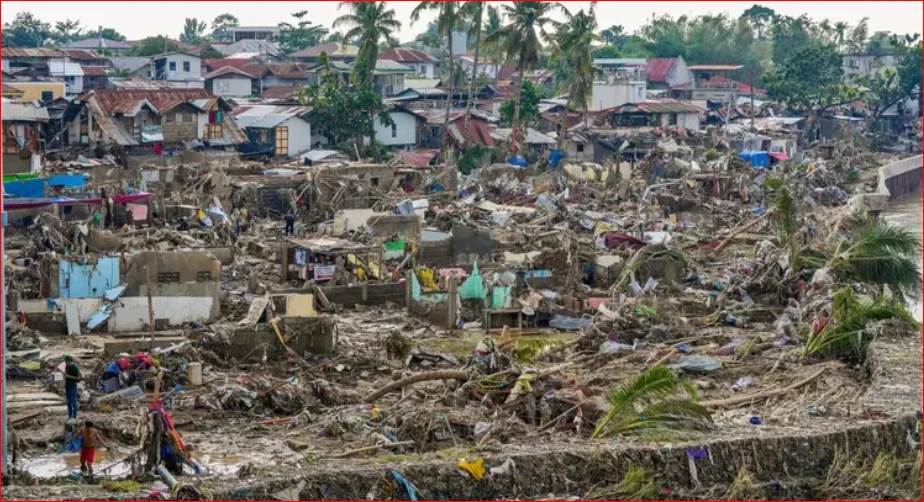
The arrival of Fung Wong comes only days after the Philippines was ravaged by Typhoon Kalmaegi, which left a trail of destruction across multiple provinces. That earlier storm caused catastrophic flooding and landslides, leaving at least 204 people dead and more than 100 others still missing.
Kalmaegi was one of the strongest storms to hit the country this year, flattening homes, submerging towns, and washing away entire villages. The recovery efforts had barely begun when word came that a new and potentially stronger storm was forming in the Pacific Ocean.
Authorities have described the back-to-back disasters as a major humanitarian crisis. In a statement released on Saturday, the Philippine government declared a nationwide state of calamity, allowing the immediate release of emergency funds and fast-tracked procurement of relief goods. Officials said that the move was both a response to Kalmaegi’s devastation and a preemptive measure to prepare for Fung Wong’s impact.
Mass Evacuations and Flight Cancellations
With memories of the recent storm still raw, officials urged residents in vulnerable areas to evacuate to higher ground before the new typhoon struck. Thousands of people in Catanduanes, Albay, Sorsogon, and other parts of the Bicol region spent the night in evacuation centers such as schools, churches, and community halls.
In some areas, local authorities made door-to-door visits to persuade residents to leave their homes, warning that the storm surge could reach up to three meters (10 feet). PAGASA described the conditions in the eastern provinces as “extremely dangerous,” advising even those living inland to prepare for strong winds and flash floods.
Several provinces announced the suspension of classes for Monday, while others moved to online learning to ensure the safety of students. Philippine Airlines also canceled multiple domestic flights, particularly those bound for Bicol, Samar, and parts of northern Luzon.
In Aurora province, on Luzon’s eastern coastline, residents spent Saturday night boarding up windows, securing rooftops, and stocking up on food and water. Local police and disaster response teams patrolled neighborhoods to ensure compliance with evacuation orders.
Among those preparing for the storm was Hagunoy, a 21-year-old hotel worker in the coastal town of Sabang. “The police came several times to tell us to evacuate,” he said. “The hotel is empty now — all the guests have left. I’m just staying behind a bit longer to secure the place before heading home.”
He and his co-workers had reinforced the property’s gates, tied the windows shut with rope, and stored valuables in waterproof containers. “The tide has already risen a lot,” he said, “but I’ll stay until it’s no longer safe, then I’ll take my motorbike home.”
Emergency Services on Alert
The government has placed its disaster response teams on the highest level of alert. More than 20,000 personnel from the Armed Forces of the Philippines, Philippine Coast Guard, and the National Disaster Risk Reduction and Management Council (NDRRMC) have been mobilized. However, many of these teams had been actively engaged in search-and-rescue operations following Typhoon Kalmaegi, and those efforts have now been suspended for safety reasons.
“The situation is very difficult,” said NDRRMC spokesperson Mark Timbal. “Our resources are stretched thin, but we are doing everything we can to prepare for Fung Wong’s impact while still responding to the devastation caused by the previous storm.”
Landslides triggered by Kalmaegi had already cut off several mountain roads, complicating relief and evacuation efforts. Emergency shelters in some regions remain overcrowded, with families who lost their homes last week now forced to brace for another round of extreme weather.
Communities on Edge
On Sunday morning, reports from Catanduanes Island described chaotic scenes as heavy rain and winds battered the coastline. Roofs were torn from houses, and power lines were brought down by falling trees. Communication in some parts of the island was lost as mobile towers were damaged.
In Sorsogon, evacuees gathered in church halls, sharing food and water as they waited for updates. Among them was Norlito Dugan, who told the AFP news agency that he decided to leave home early this time. “We decided to evacuate because the last typhoon brought floods to our area,” he said. “Now I just want to keep my family safe.”
Another resident, Maxine Dugan, said her home near the shore was already being pounded by waves. “The winds are very strong, and the waves are huge,” she said. “I didn’t want to wait until it was too late.”
Expected Path and Forecast
Meteorologists predict that Typhoon Fung Wong will continue to move northwest across the Luzon landmass through Monday. Although it is expected to weaken gradually after landfall, PAGASA warns that it will likely retain typhoon strength as it crosses the densely populated northern provinces.
The storm’s eye is projected to pass near Aurora, Nueva Ecija, and Pampanga, before exiting into the South China Sea by Tuesday morning. Once over open water, it could re-intensify slightly, though it is not expected to regain super typhoon status.
Residents in the Cordillera highlands and the Cagayan Valley region have been warned to prepare for heavy rainfall that could trigger flash floods and landslides. Riverbanks and low-lying areas are particularly at risk. PAGASA urged local officials to remain vigilant even after the storm’s center has passed, noting that “the tail-end rainbands may continue to bring hazardous weather for up to 36 hours.”
Climate and Vulnerability
The Philippines is one of the most disaster-prone countries in the world. Located along the Pacific “Ring of Fire” and within the typhoon belt, it faces an average of 20 tropical cyclones each year, roughly half of which make landfall.
Scientists note that while climate change does not necessarily increase the overall number of storms, it is intensifying their strength and impact. Warmer ocean temperatures provide more energy for typhoons to grow stronger, while a warmer atmosphere holds more moisture, leading to heavier rainfall.
“The storms that do form are becoming more destructive,” said Dr. Esperanza del Rosario, a climate scientist at the University of the Philippines. “We are seeing higher wind speeds, greater storm surges, and increased flooding — all consistent with the patterns of a warming climate.”
A Nation Holding Its Breath
As night fell on Sunday, the country’s focus turned to Luzon, where millions were preparing for the storm’s arrival. In coastal towns, streets were deserted. Fishermen had pulled their boats ashore, and shops were shuttered. Television and radio stations broadcast emergency updates around the clock.
President Ferdinand Marcos Jr. urged calm but acknowledged the gravity of the situation. “We are facing a very serious threat,” he said in a televised address. “I ask everyone to cooperate with local authorities and to prioritize safety above all else.”
By late Sunday evening, the first outer bands of Fung Wong had reached the eastern shores of Luzon, whipping palm trees and sending sheets of rain across the coastline. For the communities already battered by Kalmaegi, the coming hours would test their resilience once again.
As one resident put it, standing outside a crowded evacuation center:
“We’ve been through so many storms — but each one feels worse than the last. All we can do now is pray and wait.”