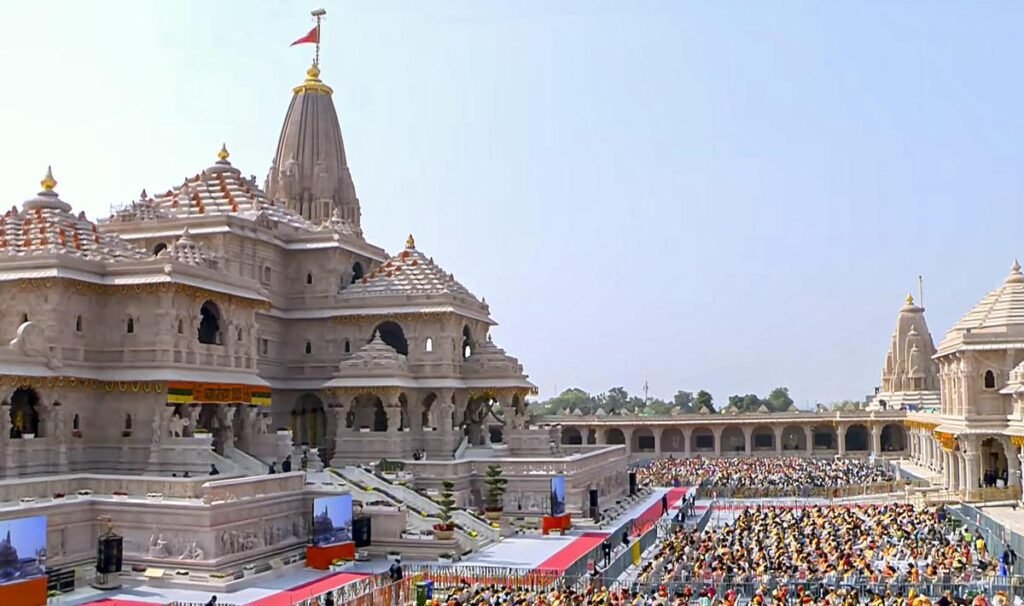
On Tuesday, November 25, 2025, a deeply symbolic and much-anticipated moment unfolded in Ayodhya: Prime Minister Narendra Modi ceremonially hoisted a saffron flag — the “Dharma Dhwaj” — atop the Ram Temple, marking the formal completion of the temple’s construction. This “Dhwaj Arohan” (flag-raising) was not just a ritual but a powerful declaration of faith, identity, and fulfillment of a journey decades in the making.
The Significance of the Ceremony
- The event was timed during the Abhijeet Muhurat, an auspicious period considered highly propitious for sacred work by Hindu priests.
- The saffron flag itself bears deep spiritual symbolism. Embroidered on it are three sacred elements:
- The Sun — representing Lord Ram’s Suryavansh lineage and valor.
- The syllable “Om” — signifying the primordial sound, cosmic order, and spiritual resonance.
- The Kovidara tree — a hybrid tree mentioned in the Ramayana, symbolizing purity, prosperity, and the ideal of Ram Rajya.
- The flag is substantial — right-angled triangular, about 10 feet high and 20 feet long, and weighing nearly 11 kg.
- It was raised on a 42-foot pole attached to the temple’s spire (shikhar).
What It Symbolizes
- According to temple priests, the Dhwaj Arohan is a “spiritual activation” of the entire temple structure — something like a second pran-pratishtha. While the earlier pran-pratishtha (in January 2024) consecrated the Ram Lalla idol, this flag ceremony is about honoring the architectural and ritual completeness of the temple itself.
- For Prime Minister Modi, this moment held profound emotional and cultural weight. He spoke of it as a healing of “wounds of centuries” — a culmination of a long spiritual resolve.
- The PM’s message resonated with unity: he emphasized that “life may be lost but promises must not be broken … what is said must be done.”
- From the government’s side, the flag is framed as a message of dignity, unity, and cultural continuity — reflecting the ideals of Ram Rajya.
The Rituals, the Guests, and the Atmosphere
- The ceremony was attended by thousands: dignitaries, seers, sadhus, and more than 8,000 invited guests.
- Among those present were RSS Chief Mohan Bhagwat, Uttar Pradesh Governor Anandiben Patel, and Chief Minister Yogi Adityanath.
- Before hoisting the flag, PM Modi performed devotional rituals: he visited the Sapt Mandir, the Sheshavatar Mandir, and the Mata Annapurna Mandir, and offered prayers in the garbha griha (sanctum) of Ram Lalla.
- All 44 doors of the temple were opened for the occasion, adding to the ritual grandeur.
Symbolism Beyond the Ceremony
- The Dharma Dhwaj isn’t merely a physical flag — it’s a message. The Sun, Om, and Kovidara tree collectively evoke the eternal values of Sanatan Dharma: righteousness, unity, and spiritual rootedness.
- The timing itself is rich: the flag-raising coincided with Vivah Panchami, the traditional day that commemorates the divine wedding of Ram and Sita.
- According to PM Modi, this is not just a temple event; it’s a step in a broader vision for a “developed and strong nation” by 2047, as India gears toward its centenary of independence.
Reflections: What This Moment Means for India
- Spiritual fulfillment: For many devotees, the hoisting of the Dharma Dhwaj marks the final piece in the temple’s spiritual journey — a visible affirmation of their faith and long-cherished hopes.
- Cultural unity: The event signals a shared heritage. While deeply rooted in Hindu tradition, the messaging around dignity, unbroken promises, and nation-building points to a broader cultural resonance.
- Political symbolism: Given PM Modi’s association with earlier milestones (foundation laying in 2020, consecration in 2024), the ceremony underscores his role in this historic narrative.
- Legacy building: The Dhwajarohan can be seen not just as the end of construction but the beginning of a new chapter — where the temple is not just a site of worship, but a symbol of collective pride, identity, and aspiration.
Conclusion
The hoisting of the Dharma Dhwaj by Prime Minister Modi is more than a ceremonial act. It is a richly layered moment — deeply spiritual, culturally resonant, and historically significant. It celebrates the completion of the Ram Mandir’s physical structure, but it also represents a culmination of centuries of faith, sacrifice, and vision. For millions, it is a promise fulfilled. For India, it may well be a turning point: a reaffirmation of values, unity, and the enduring power of belief.