A U.S. Marine Corps F-35B Lightning II fighter jet crashed near Marine Corps Air Station (MCAS) Miramar in San Diego, California, on Friday, triggering a fire and prompting an immediate emergency response from military personnel and local firefighters. The pilot successfully ejected from the aircraft before impact and was transported to a nearby medical facility with non-life-threatening injuries, according to officials. The cause of the crash remains under investigation.
Crash Near Miramar Air Base
The incident occurred close to the runway at MCAS Miramar, one of the U.S. Marine Corps’ most important aviation facilities. Witnesses reported hearing a loud explosion before seeing thick black smoke rising into the sky. Emergency crews quickly arrived at the scene as flames spread through nearby vegetation.
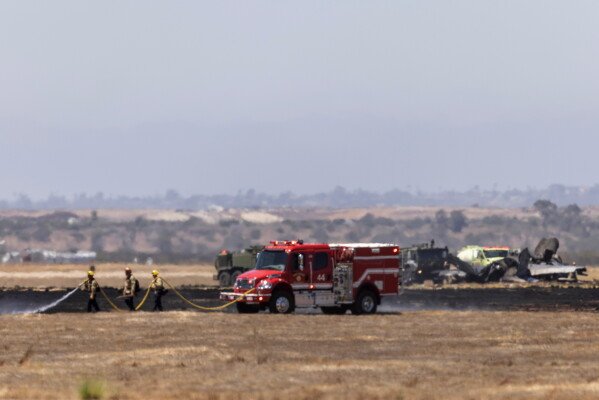
Television aerial footage showed the aircraft broken into multiple sections in an open field while firefighters worked to extinguish the blaze using water and fire retardant. Military authorities secured the crash site shortly afterward to begin recovery and investigation operations.
Pilot Ejects Safely
The Marine Corps confirmed that the pilot managed to eject moments before the aircraft struck the ground. Officials said the pilot suffered only minor injuries and was taken to a local hospital for evaluation.
Eyewitnesses described seeing the pilot descend safely under a parachute shortly before the aircraft exploded upon impact. Military officials have not released the pilot’s identity, citing privacy and operational procedures.
The successful ejection highlights the effectiveness of the F-35’s advanced emergency escape system, which is designed to protect pilots during catastrophic aircraft failures.
Fire Quickly Contained
The crash ignited a brush fire in the area surrounding the wreckage. Firefighters from both the military base and local agencies responded rapidly, preventing the flames from spreading beyond the immediate crash site.
Authorities confirmed there were no reports of civilian injuries or damage to nearby buildings. The fire was contained within a relatively short period, allowing investigators to begin examining the wreckage.
Officials emphasized that safety measures were immediately implemented, including restricting access to the affected area while emergency crews completed their work.
Investigation Underway
The U.S. Marine Corps has launched a formal investigation to determine what caused the accident. At this stage, officials have not indicated whether mechanical failure, pilot error, weather conditions, or another factor contributed to the crash.
Military investigators will examine flight data, maintenance records, witness statements, and recovered aircraft components. Until the investigation concludes, no official explanation for the incident will be provided.
The accident has been classified as a Class A aviation mishap—the military’s highest category for aviation accidents—because it involved the destruction of an aircraft valued at more than $2 million.
About the F-35B Lightning II
The aircraft involved was an F-35B Lightning II, the short takeoff and vertical landing (STOVL) variant developed primarily for the U.S. Marine Corps.
The F-35B is one of the world’s most advanced multirole stealth fighter aircraft. It combines stealth technology, advanced sensors, electronic warfare capabilities, and precision strike capabilities into a single platform. Its unique ability to take off from shorter runways and land vertically makes it especially valuable for expeditionary operations and amphibious assault ships.
Each F-35B costs well over $100 million, making it one of the most expensive fighter aircraft ever produced. The broader F-35 program serves the U.S. Air Force, Navy, Marine Corps, and numerous allied nations worldwide.
Previous F-35 Incidents
Although the F-35 has become a cornerstone of modern military aviation, several crashes and emergency incidents have occurred since the aircraft entered operational service. Most investigations have identified factors ranging from mechanical malfunctions to pilot-related issues.
Despite these incidents, defense officials continue to describe the aircraft as one of the safest modern fighter platforms due to extensive safety systems, rigorous maintenance procedures, and advanced pilot training. Nearly all recent U.S. F-35 crashes have resulted in successful pilot ejections, demonstrating the effectiveness of the aircraft’s safety features.
Importance of MCAS Miramar
Marine Corps Air Station Miramar serves as the headquarters of the 3rd Marine Aircraft Wing and plays a critical role in Marine Corps aviation operations. Located approximately 10 miles north of downtown San Diego, the base supports thousands of Marines, sailors, civilian employees, and numerous aviation units.
Miramar has a long history of military aviation and regularly hosts training exercises involving advanced fighter aircraft, helicopters, and transport planes. Because of its operational significance, any aircraft accident at the base receives immediate attention from military leadership and aviation safety investigators.
Conclusion
The crash of the U.S. Marine Corps F-35B fighter jet near MCAS Miramar marks another significant aviation incident involving one of America’s most advanced military aircraft. While the loss of the aircraft is substantial, the pilot’s successful ejection and the rapid containment of the resulting fire prevented a far more serious outcome.
As investigators work to determine the cause, the findings will likely contribute to ongoing efforts to enhance flight safety, maintenance procedures, and operational readiness across the F-35 fleet. For now, military officials remain focused on recovering the wreckage, supporting the injured pilot, and conducting a thorough investigation to prevent similar incidents in the future.