Two years after Nick Saban stepped away from the sidelines, his presence still looms over college football’s biggest stage.
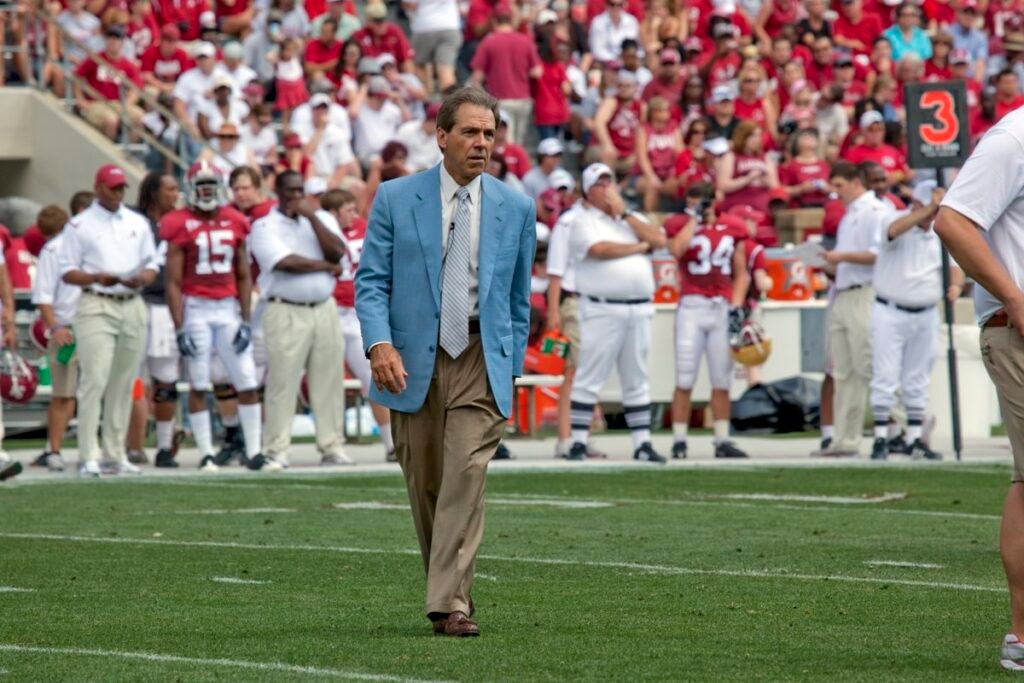
Hours before a College Football Playoff quarterfinal kicked off Thursday, the 74-year-old former Alabama coach sat on an ESPN set tucked into the Rose Bowl end zone in Pasadena, California. Now a television analyst after retiring in 2024 as the most decorated coach of the modern era, Saban no longer stalks the sideline. Yet the playoff results have underscored a simple truth: his influence has never left.
The final four teams in the College Football Playoff — Miami, Oregon, Indiana, and Ole Miss — are all led by head coaches who once worked under Saban.
Miami, coached by Mario Cristobal, dismantled defending national champion Ohio State in a quarterfinal Wednesday. The Hurricanes will face Ole Miss in next week’s semifinals, where Pete Golding — Saban’s former defensive coordinator at Alabama — was elevated to head coach just last month after another Saban protégé departed.
On the other side of the bracket, Oregon coach Dan Lanning, who served as an Alabama graduate assistant in 2015, will meet Indiana’s Curt Cignetti, a member of Saban’s first Alabama staff from 2007 to 2011.
Even if Ole Miss had fallen earlier, the semifinal field still would have been dominated by Saban’s coaching tree. Georgia, eliminated in the quarterfinals, is led by Kirby Smart, Saban’s longest-tenured coordinator in Tuscaloosa.
Saban’s demanding personality, meticulous attention to detail, and relentless competitiveness became hallmarks of his success. He famously built programs around a rigid “process,” insisting that no task was too small and no standard negotiable. That approach delivered one national title at LSU and six more at Alabama — and it left a lasting imprint on the assistants who learned under him.
“It was a really important part of my journey,” Cignetti said this week, before Indiana’s stunning 38-3 demolition of Alabama in the quarterfinals. “I learned so much from Coach Saban — organization, standards, stopping complacency. I wouldn’t be where I am today without that time.”
A Football Education Like No Other
Cristobal arrived at Alabama in 2013 already experienced as a head coach, yet he has said his four years under Saban amounted to a “football PhD.” During that span, the Crimson Tide won one national championship and played for another.
When Cristobal became Oregon’s head coach in 2018, he modeled nearly every detail of the program — from offseason workouts to staff responsibilities — on Saban’s blueprint. That influence has carried over to his tenure at Miami.
“That’s how you win games this time of year — by dominating the line of scrimmage,” Saban told Cristobal during ESPN’s College GameDay after Miami’s quarterfinal win.
“Well, that was one of the greatest lessons I learned from you at Alabama,” Cristobal replied. “You used to tell us all the time, ‘Mass kicks a–.’”
Ole Miss’s path to the semifinals provided another vivid example of Saban’s lingering reach. When Lane Kiffin debated leaving Ole Miss for LSU a month ago, he called Saban for guidance. Kiffin ultimately took the LSU job, citing that conversation as pivotal.
Ole Miss quickly promoted Golding, who had once recruited players by saying, “I work for the greatest coach of all time.” In just his second game as head coach, Golding led the Rebels to a major upset over Georgia and Smart — another Saban disciple.
Beating Alabama With Alabama Lessons
Lanning’s coaching journey included a formative year as an Alabama graduate assistant before he later worked under Smart at Georgia. He has spoken often about Saban’s openness to ideas from any level of the staff and his unwavering commitment to routine.
That discipline, Lanning said, could make Saban seem robotic — but it was paired with an ability to adapt as the sport evolved.
“Some people coming from that tree tried to be Nick,” Lanning said. “But Nick was Nick. Coach Saban was himself every day. What I learned is you’ve got to be you — and you’ve got to be relentlessly consistent if you want to last.”
Saban’s relationship with Cignetti runs especially deep. He hired him in 2007 as Alabama’s receivers coach and recruiting coordinator. Cignetti’s father, Frank, had hired Saban as an assistant at West Virginia nearly three decades earlier.
By 2009, Alabama captured its first national championship in 17 years with help from recruits Cignetti had helped secure. When Cignetti left in 2011 to coach in Division II, Saban worried he was derailing his career. Instead, Cignetti won quickly, climbed the coaching ladder, and eventually landed at Indiana in 2024.
The job came with daunting history. Indiana entered the season with the most losses in Football Bowl Subdivision history and hadn’t won a postseason game since 1991.
Yet on Thursday, Saban watched from the Rose Bowl sideline as Cignetti’s Hoosiers handed Alabama the most lopsided postseason defeat the program has ever suffered. The 38-3 rout was both stunning and symbolic — a longtime underdog physically and tactically overpowering the sport’s former gold standard.
“I think about working for Coach Saban almost every day,” Cignetti said. “It shaped my growth and development.”
“Philosophically, what we do here isn’t that different from Alabama,” he added. “There isn’t a day that goes by where I don’t draw from those experiences.”
Two years after his retirement, Nick Saban may no longer coach on Saturdays — but college football is still, unmistakably, playing his game.