Every spring, as winter loosens its grip and the air turns fragrant with blossoms, streets across India erupt into a kaleidoscope of color. Laughter echoes through neighborhoods, music pulses from every corner, and clouds of bright powder fill the sky. This is Holi, one of the most joyful and widely celebrated festivals in the Hindu calendar — a celebration that transcends religion, geography, and age.
Rooted in ancient tradition yet vibrantly alive in modern culture, Holi is much more than a festival of colors. It is a symbolic triumph of good over evil, a celebration of love and unity, and a heartfelt welcome to spring.
The Mythological Roots of Holi
Like many Hindu festivals, Holi draws from powerful stories in Hindu mythology. The most prominent legend is that of Prahlada and his tyrannical father, Hiranyakashipu. According to tradition, Hiranyakashipu demanded to be worshipped as a god, but his son Prahlada remained devoted to Vishnu. Enraged, the king plotted to kill his son.
He enlisted the help of his sister, Holika, who was believed to be immune to fire. She tricked Prahlada into sitting with her on a burning pyre. But in a divine twist, Holika perished in the flames while Prahlada emerged unharmed, protected by his unwavering faith. This event symbolizes the victory of righteousness over evil — a theme that lies at the heart of Holi.
The night before the main celebration, communities gather for Holika Dahan, where bonfires are lit to commemorate this story and signify the burning away of negativity.
Another beloved legend links Holi to Krishna and Radha. It is said that Krishna, known for his playful nature, once complained about Radha’s fair complexion compared to his darker skin. His mother jokingly suggested he color Radha’s face. This playful act is believed to have inspired the joyous throwing of colors that defines Holi today.
A Festival of Colour and Connection
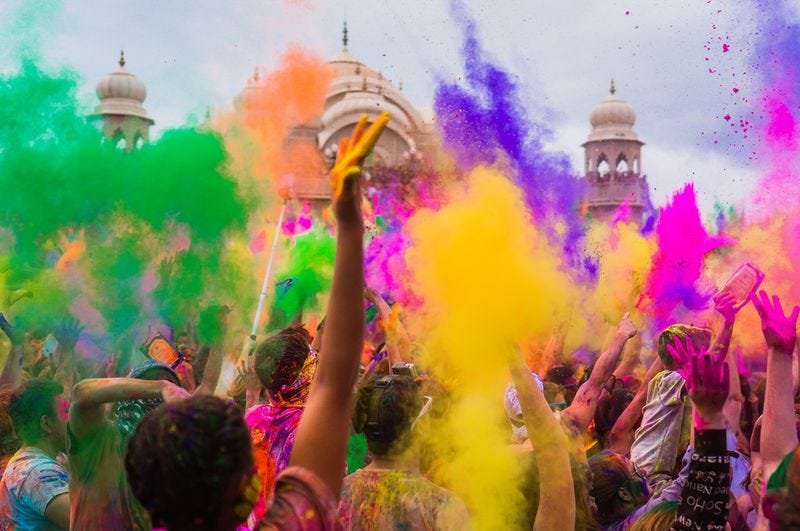
On the day of Holi, known as Rangwali Holi, social boundaries blur. Friends, families, neighbors, and even strangers gather in open spaces armed with gulal (colored powder) and water balloons. Bright reds, yellows, greens, blues, and pinks transform streets into living canvases.
The colors themselves carry symbolic meaning:
- Red represents love and fertility
- Yellow symbolizes turmeric and health
- Green signifies new beginnings
- Blue is associated with Krishna
- Pink expresses joy and friendship
Music and dance are essential elements of the celebration. Traditional folk songs mix with contemporary beats as people dance freely in the streets. Delicious festive treats like gujiya (sweet dumplings), malpua, and thandai are shared generously, reinforcing the festival’s spirit of hospitality and unity.
Holi creates a rare moment where social hierarchies soften. Old grievances are forgiven, differences are set aside, and people greet one another with the phrase, “Happy Holi!” It is a festival that encourages renewal — emotionally as well as seasonally.
Holi Across India
While Holi is celebrated nationwide, regional traditions add unique flavor to the festivities.
In Mathura and Vrindavan, towns closely associated with Krishna, celebrations last for several days. The atmosphere is especially devotional, blending spiritual rituals with playful color-throwing. In Barsana, the famous Lathmar Holi sees women playfully chase men with sticks in a reenactment of Krishna’s teasing of Radha and her companions.
In West Bengal, Holi coincides with Dol Jatra, marked by singing and artistic performances inspired by the poet Rabindranath Tagore. In Punjab, the Sikh community celebrates Hola Mohalla, featuring martial arts displays and processions.
Each region adds its own cultural nuance, yet the central theme of joy and unity remains constant.
Holi Beyond India
Though deeply rooted in Hindu tradition, Holi’s appeal has expanded far beyond India’s borders. Thanks to the Indian diaspora and growing global curiosity about cultural festivals, Holi is now celebrated in countries including the United States, the United Kingdom, Canada, Australia, South Africa, and Nepal.
Major cities host vibrant Holi festivals in parks and public spaces, often blending traditional rituals with modern music festivals. Universities, cultural organizations, and community groups organize events that attract people of all backgrounds.
In many places, Holi has evolved into a broader celebration of diversity and inclusion. While the religious origins are respected, the universal themes of joy, renewal, and togetherness resonate across cultures.
Modern Holi: Balancing Tradition and Change
As Holi grows in popularity, awareness around environmental sustainability has also increased. Traditionally, natural dyes made from flowers, herbs, and spices were used. In recent decades, synthetic colors have raised concerns about skin irritation and environmental harm. Today, many communities are returning to eco-friendly, plant-based powders.
Water conservation has also become a focus, especially in drought-prone areas. Campaigns encourage “dry Holi” celebrations that rely primarily on colored powders rather than excessive water use.
Despite modernization, the core message of Holi remains intact: the renewal of hope, the celebration of life, and the triumph of positivity.
The Spirit of Holi
At its heart, Holi is about transformation. It marks the end of winter and the beginning of spring — a time when nature itself bursts into color. Symbolically, it invites individuals to shed past negativity, repair relationships, and embrace fresh beginnings.
In a world often divided by differences, Holi offers a simple yet profound message: joy is universal, color belongs to everyone, and unity is something to celebrate.
Whether experienced in the bustling streets of India or in a park halfway across the world, Holi’s vibrant spirit continues to bring people together — one splash of color at a time.