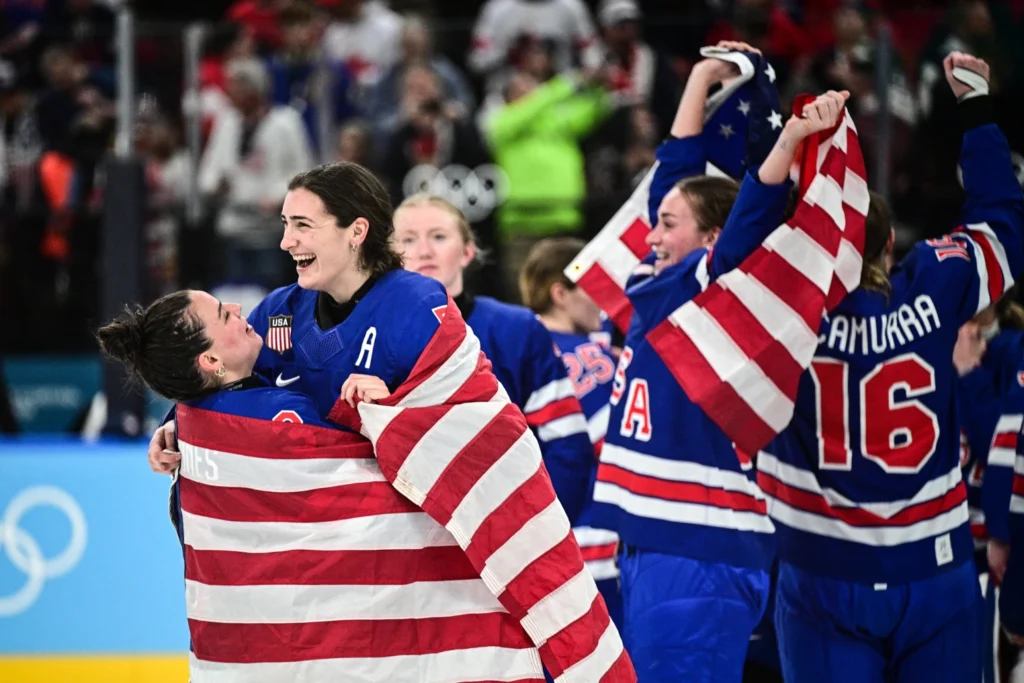
The 2026 Winter Olympics in Milan–Cortina were historic for Team USA Women’s Ice Hockey. After a dominant performance that culminated in a gold-medal victory over Canada, the U.S. women’s hockey team earned not just Olympic hardware but admiration around the world for their grit, teamwork, and excellence on the ice.
However, in the wake of that triumph, a moment that should have been purely celebratory took an unexpected turn — not because of anything the athletes themselves did, but because of a political figure’s offhand remark that sparked a national conversation about respect, gender, and how we honor athletic achievement.
The Controversial Joke That Sparked Outrage
After the U.S. men’s hockey team won their own gold medal — their first since the famed “Miracle on Ice” in 1980 — former President Donald Trump contacted the men’s team to congratulate them. In that celebratory call, he pointedly quipped that he would have to invite the women’s team to the State of the Union address too — “otherwise he would probably be impeached.”
The comment, intended as a joke, was met with laughter from members of the men’s team — a reaction that instantly spread across social media as video clips went viral. Many viewers interpreted the laughter not as lightheartedness but as a dismissal of the women’s accomplishments, given that both teams had won gold medals on the biggest stage in sport.
Almost immediately, critics — both inside and outside the hockey community — expressed disappointment. Social media users and commentators argued the joke underscored long-standing gender biases in sports and public life, posing questions about how female athletes are respected and recognized compared to their male counterparts.
Hilary Knight’s Measured, Powerful Response
Rather than react with anger or derision, Hilary Knight, captain of the U.S. women’s hockey team and one of the most decorated players in the sport’s history, offered a thoughtful and purposeful response. In an interview on ESPN’s SportsCenter, Knight called the comment a “distasteful joke” and lamented that it had shifted attention away from the women’s accomplishment.
But she did something equally important: she reframed the narrative.
Knight didn’t just criticize the joke — she used it as a teaching moment about how society talks about women, not just in sports but in every competitive arena.
This line resonated widely, not only because of its clarity but because it came from someone who had earned the right to speak on behalf of her sport. Knight’s team had just etched its name into American Olympic lore, winning the women’s hockey gold medal for the third time in program history. Her perspective was anchored in achievement — not defensiveness.
Unity, Respect, and the Men’s Team Response
Interestingly, while the initial moment of laughter became the flashpoint of criticism, many members of the men’s team later expressed regret. Backup goaltender Jeremy Swayman acknowledged that the team “should’ve reacted differently” and emphasized their genuine admiration for their female counterparts.
Other men’s team players and figures close to Team USA echoed this sentiment, stressing that respect and camaraderie existed between both teams — a message that Knight and others on the women’s team reiterated.
This nuance is crucial: the controversy wasn’t just about a joke; it was about what that joke symbolized to many people. Was it a simple misstep? Or was it reflective of a larger pattern where women’s successes are downplayed or overshadowed?
The Broader Cultural Response
The meme-ready moment of laughter became a catalyst for conversations across the country. Fans and critics on platforms like X (formerly Twitter) and Reddit debated the significance of the joke and the reactions it drew. Some users argued that the women’s team deserved more than a casual nod; others defended the men’s team, saying they were caught up in an emotional moment and didn’t intend disrespect.
Public interest also extended beyond sports circles into discussions about politics, gender equality, and the role of public figures in celebrating national achievements. For many critics, the moment highlighted a broader societal issue: the enduring challenge of recognizing women’s accomplishments on equal terms.
A Focus on the Achievements — Not the Controversy
Despite the media attention around the comment, Knight and her teammates were steadfast in redirecting the public focus back to what really mattered — the achievement itself.
The U.S. women’s hockey team was celebrating an extraordinary event: a gold medal earned through teamwork, skill, resilience, and passion. Knight herself set Olympic scoring records and played a pivotal role in securing the podium finish.
Forward Kelly Pannek echoed that sentiment, emphasizing that the team’s main priority was honoring the effort, dedication, and historic significance of their Olympic run — rather than allowing an offhand remark to dominate the narrative.
And while some viewed the controversy as a distraction, Knight saw it as an opportunity.
What This Moment Means for Women’s Sports
The response by Team USA’s women’s hockey players offers an inspiring example of leadership and perspective under public scrutiny. It wasn’t just about defending themselves — it was about elevating the conversation around gender equity in sport and society.
In recent years, women’s athletics have made tremendous strides in visibility, support, and recognition. From soccer to basketball to hockey, female athletes are commanding larger audiences, earning unprecedented accolades, and shaping cultural conversations. Yet the reaction to a single joke shows that even champions can find their victories reframed in ways that diminish their achievements.
That’s one reason why Knight’s response matters so much. By refusing to let an ill-timed remark define her team’s legacy, she and her teammates reminded the world that achievements on the field — or the ice — should stand on their own merits.
Moving Forward: Respect, Recognition, and the Power of Voice
The legacy of the 2026 U.S. women’s hockey team will be measured by more than goals scored or medals won. It will also be shaped by how these athletes responded in a moment when society’s attention was fleetingly distracted by controversy.
They chose focus over distraction, pride over resentment, and leadership over reaction. Their message — “Women aren’t less than” — resonates far beyond the rink, echoing into realms where women continue to fight for parity, respect, and recognition.
In a world where female athletes often have to defend their worth, they stood firm and reminded us all of something important: champions are defined not just by how they win games, but how they carry themselves in the moments that follow.